

Retaliatory Airbnb reviews may qualify for removal when a guest posts biased feedback because a host reported a documented Airbnb policy violation. The strongest response is to preserve the evidence, connect the review to Airbnb’s retaliation standard, and submit a focused removal request.
Not every harsh review after a disagreement, refund request, or damage claim is retaliatory. Hosts must separate negative opinions from reviews that meet Airbnb’s specific removal criteria. This guide explains five practical steps, plus a decision check, evidence checklist, request template, public response example, and prevention workflow for hosts.
Retaliatory Airbnb reviews may qualify for removal when a guest violated an Airbnb policy, was notified, and then posted biased feedback because the violation was reported. Preserve the message trail, build a clear timeline, submit a policy-based removal request, and publish a calm public response if Airbnb leaves the review online. Before acting, use this quick check: was there a policy violation, did you notify the guest, did you report it, and can you connect the later review to that report? If any link is missing, strengthen the evidence before appealing and avoid assumptions based on timing alone.
Does the Review Qualify as Retaliation?
| Situation | Likely Retaliatory? | Best Next Step |
|---|---|---|
| A guest dislikes a published house rule. | Not by itself. | Document the issue and respond calmly. |
| A guest violates an Airbnb policy, is notified, and reviews you after being reported. | Possibly. | Build a timeline and request removal. |
| A guest criticizes an AirCover or damage claim. | Not automatically. | Look for a separate policy violation. |
| A guest threatens a bad review to obtain an unwarranted refund. | Potential policy violation. | Preserve the message and report it. |
| A guest leaves a low rating without explaining why. | Not by itself. | Check the written review and supporting context. |
Keep reservation conversations easier to retrieve with the AdvanceCM Unified Inbox before disputes escalate or evidence disappears.
What Counts as a Retaliatory Airbnb Review?
A review is not retaliatory simply because it is negative, inaccurate, or posted after a dispute. Under Airbnb’s Reviews Policy, a review may be retaliatory when the reviewer committed a policy violation, was notified, and then left biased feedback because the violation was reported. Airbnb also says a review discussing an AirCover or Resolution Center claim is not automatically retaliatory. A guest may criticize how a dispute was handled without violating the policy. A consistent Airbnb guest review strategy helps hosts document timing, use factual wording, and evaluate problem stays without reacting emotionally.
Decision Flow: Is the Review Retaliatory?
Ask four questions. Did the guest violate an Airbnb policy? If not, the review probably does not meet the retaliation test. If yes, ask whether the guest was notified. If not, the evidence trail may be incomplete. If yes, ask whether the violation was reported to Airbnb. If not, the case may not fit the criteria. If yes, ask whether evidence connects the review to the report. If not, timing alone may not prove retaliation. If yes, prepare a policy-based removal request. Turn this flow into a graphic with yes-or-no branches for faster scanning.
1. Check the Review Against Airbnb’s Policy Test
Answer five questions: what policy violation occurred, what evidence confirms it, when was the guest notified, when was the violation reported, and what connects the review to that report? The original issue must involve an Airbnb policy, not a preference, unpublished expectation, or optional request. A complaint after a checkout reminder is not automatically retaliation. A stronger case may involve a prohibited party, threats, unauthorized guests, damage, or another documented violation that the host reported. Timing can support the argument, but timing alone does not prove it. Connect the full sequence clearly.
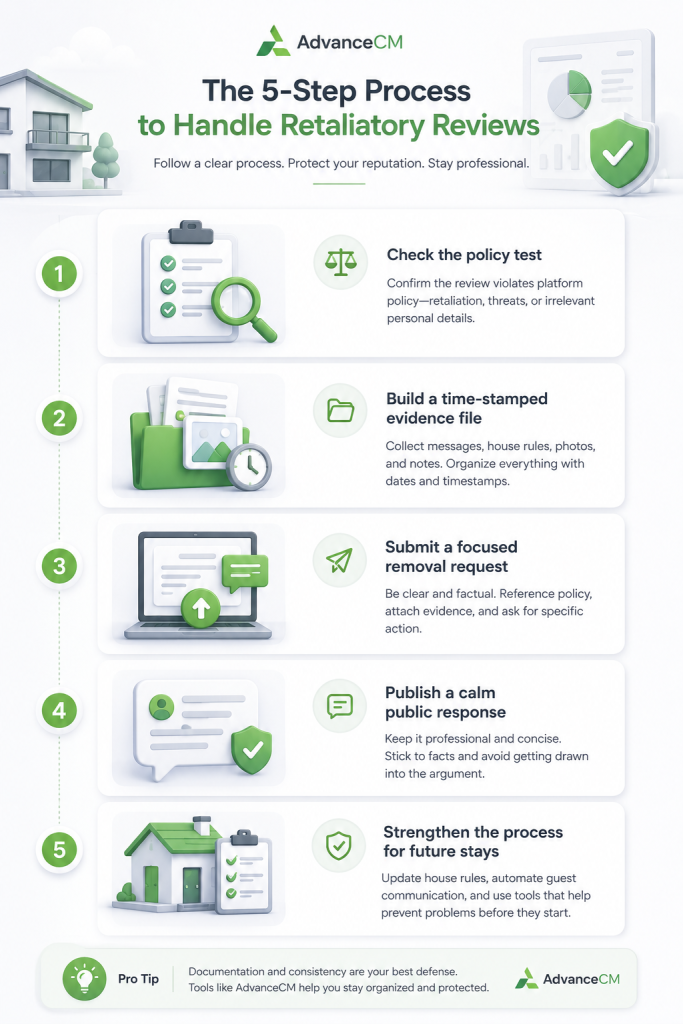
2. Build a Time-Stamped Evidence File
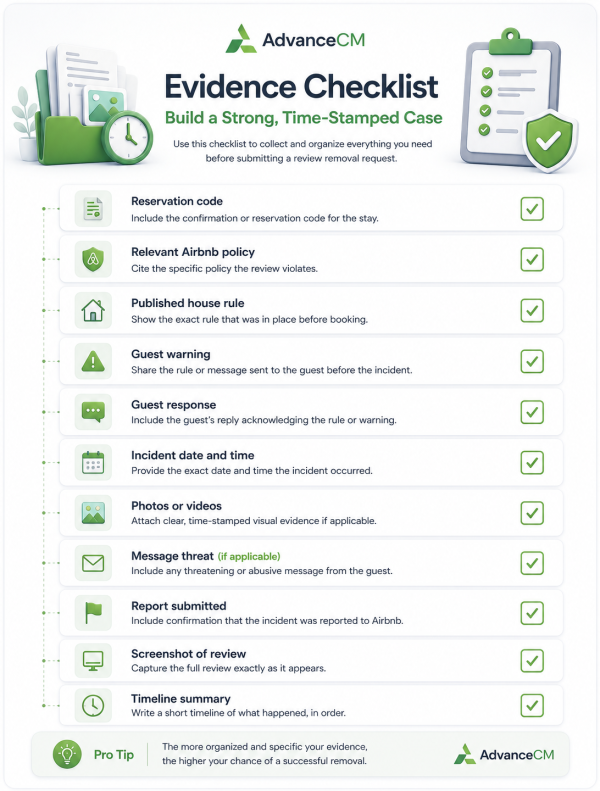
Collect relevant records before submitting a request. The reviewer should understand what happened without sorting through unrelated screenshots or emotional explanations. Save the reservation code, listing, applicable policy, published house rule, incident date, guest warning, guest response, report time, photographs, permitted noise records, access logs, contractor reports, review threat, and a copy of the published review. Arrange everything chronologically. Avoid sensitive information that does not help prove retaliation. A short evidence summary should identify the rule, incident, warning, report, threat, and review. That structure makes each attachment serve a purpose instead of creating noise.
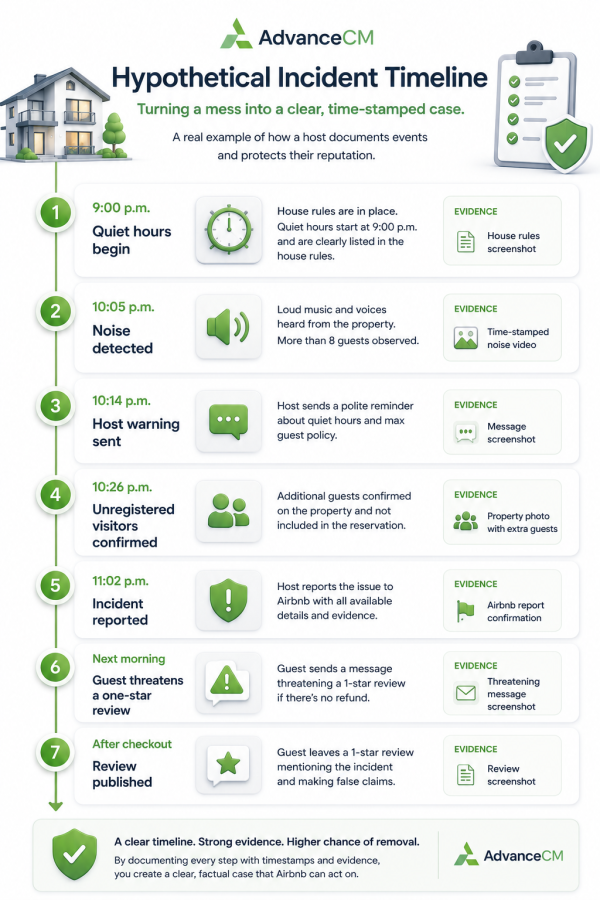
Hypothetical Timeline
Use a fictional example to show the sequence. At 9:00 p.m., quiet hours begin. At 10:05 p.m., a permitted noise monitor records sustained noise. At 10:14 p.m., the host sends a warning through the reservation thread. At 10:26 p.m., the guest confirms unregistered visitors are present. At 10:40 p.m., the host asks them to leave. At 11:02 p.m., the host reports the incident. At 8:15 a.m. the next day, the guest threatens a one-star review. After checkout, the guest publishes it. This timeline is stronger than random screenshots because every record supports one part of the policy test.
How AdvanceCM Supports the Evidence Workflow
AdvanceCM is Tokeet’s latest channel manager, and Unified Inbox centralizes supported OTA, email, SMS, WhatsApp, Facebook, and Instagram conversations. Direct OTA messaging, attachments, templates, and quick replies can help operators find relevant exchanges without moving between separate inboxes. This workflow does not decide whether Airbnb removes a review; it helps teams retrieve communication needed for a clear request. See how Unified Inbox centralizes OTA guest communication. Keep the product claim practical: the value is faster retrieval, fewer missed threads, and a cleaner handoff when another team member prepares the evidence for support review later.

3. Submit a Focused Review-Removal Request
Do not build the request around “This review is unfair” or “The guest is lying.” Use Airbnb’s review-removal request process and structure the submission around policy. Identify the reservation, state the violation, show when the guest was notified, show when it was reported, explain the connection to the review, attach relevant evidence, and ask Airbnb to assess retaliation. Airbnb says users may upload supporting documents, usually receive a decision by email within 48 hours, and may submit no more than two removal requests for the same review. The stated time frame does not guarantee removal.
Removal Request Template
I am requesting removal of the review for reservation [code] under Airbnb’s retaliation provision. The guest violated [policy] on [date and time]. The guest was notified through [message thread] at [time], and the incident was reported at [time]. The attached evidence shows [brief connection between the report and review]. Please assess the review under Airbnb’s Reviews Policy. Replace bracketed fields and delete anything you cannot prove. Before: “This guest is lying and hurting my business.” After: “The guest held an unauthorized party, was warned at 10:14 p.m., was reported at 11:02 p.m., and then threatened a review.”
4. Publish a Calm Public Response
Airbnb may decide the review does not meet removal criteria. When that happens, write for guests, not the reviewer. Keep the response brief, factual, polite, and focused on the hosting standard. Example: “Thank you for your feedback. During this reservation, we addressed a violation of the property’s no-party rule. We apply that rule to protect guests, neighbors, and the property.” Avoid information, access records, damage documents, or accusations you cannot verify publicly. The same principle applies when dealing with difficult vacation rental guests: set written boundaries, document the issue, and avoid matching any tone.
5. Strengthen the Process Before the Next Dispute
You cannot prevent every retaliatory review, but you can create a better record before conflict escalates. Publish clear house rules, restate restrictions before arrival, keep communication in the platform thread, identify the rule in warnings, record the time, explain the corrective action required, escalate consistently, and store records with the reservation. A stronger warning names the observation, rule, time, and requested action. A consistent vacation rental guest screening process can surface problems before arrival by confirming group size, trip purpose, and acknowledgment of rules. Never link refunds or charges to a review.
Common Mistakes That Weaken an Appeal
Hosts often weaken cases by focusing on personality instead of policy. Avoid calling the guest dishonest without evidence, submitting unrelated complaints, moving communication to messages, repeating the appeal without proof, posting an emotional response, offering compensation for changing a review, exaggerating the violation, publishing sensitive information, or treating every low rating as retaliation. The objective is not to prove the guest was unpleasant. It is to show that the review meets Airbnb’s policy standard. Explore AdvanceCM Unified Inbox to organize supported OTA and guest communication before dispute forces your team to reconstruct the record.
Conclusion
Retaliatory Airbnb reviews should be handled through evidence, policy, and restraint. Confirm that the situation meets Airbnb’s retaliation standard, build a chronological record, and submit a removal request connecting the violation, notification, report, and resulting review.
If the review remains, publish a brief response that explains the hosting standard without attacking the guest. Then strengthen the communication, screening, and incident-recording process used for future reservations.
FAQs
- Can Airbnb remove a retaliatory guest review?
Airbnb may remove a review when it violates the platform’s Reviews Policy, including its retaliation provision. Removal is not guaranteed, so the request should address every part of Airbnb’s policy test. - Is every negative review after a damage claim retaliatory?
No, a negative review posted after an AirCover, refund, or damage dispute is not automatically retaliatory. The host must show that the guest posted biased feedback because a separate Airbnb policy violation was reported. - What evidence supports an Airbnb review-removal request?
Useful evidence can include platform messages, time-stamped photographs, published house rules, incident reports, access records, and messages threatening a negative review. The evidence should establish a clear sequence rather than simply show that a disagreement occurred. - Should a host respond publicly to an unfair Airbnb review?
A brief public response can provide context when Airbnb leaves the review online. Keep it factual, avoid private details, and write for prospective guests rather than the original reviewer. - How can hosts reduce the risk of retaliatory Airbnb reviews?
Hosts can use clear rules, pre-arrival reminders, written warnings, consistent screening, and documented incident procedures. These practices cannot prevent every negative review, but they create a stronger record when a dispute occurs.

Welcome to Tokeet’s Podcast — your trusted source for insights, trends, and strategies shaping the vacation rental industry. Each episode features expert interviews, data-driven analysis, and practical tips to help property managers grow their businesses, improve guest experiences, and stay ahead in a rapidly evolving market. Whether you’re new to short-term rentals or managing a large portfolio, tune in to stay informed and inspired.
Some days just don’t work for a guest arrival, whether it’s a holiday, a maintenance window, or a turnover day your team can’t cover. This episode walks through check-in and check-out restrictions, the most requested feature in AdvanceCM, now live in the Rentals module. You’ll hear how to block arrivals or departures for a date range, such as December 24 to 26, and how to allow check-ins only on the weekdays you choose. We also cover channel-specific rules, like keeping Airbnb to Friday and Saturday arrivals while direct bookings stay open through Sunday. Finally, we explain what to check before switching rules on, from existing reservations to sync time and visibility on booking sites.
Key Takeaways:
✅ Block check-ins or check-outs for any date range
✅ Limit arrivals to the weekdays you choose
✅ Set different rules for each booking channel
✅ Existing reservations stay unchanged
✅ More restrictions mean fewer guests can book, so review rules each season
Related Links:
Company: https://www.tokeet.com/Blogs: https://www.tokeet.com/blog/Blog: Check-in and Check-out Restrictions: How to Set Them in AdvanceCM 👉 https://blog.tokeet.com/check-in-and-check-out-restrictions/
This is a public episode. If you would like to discuss this with other subscribers or get access to bonus episodes, visit podcast.tokeet.com