

You’ve just received a message at 11 PM. The guest wants a technician sent immediately for an AC unit that’s “leaking.” You investigate remotely, diagnose the issue as simple condensation from overuse, and guide them to adjust the temperature. They reject your solution and demand professional service, on a holiday weekend. Three days later, after they’ve checked out, you confirm there was never a leak. The damage? Hours of your time, elevated stress, and the looming threat of a one-star review.
This scenario plays out in vacation rentals every single day. According to industry data, 31% of property managers report that rising guest expectations have made service delivery increasingly challenging. More than half (54%) note increased demands from guests over the past two years. The tension isn’t just about maintenance issues, it’s about fundamentally different views of what a vacation rental experience should be.
This guide covers five proven tactics that help you handle challenging guests professionally while protecting your property, your reviews, and your sanity. You’ll learn how to prevent most difficult situations before they start, manage conflicts when they arise, dealing with difficult guests. and maintain boundaries without sacrificing hospitality.
Why Expectations and Boundaries Matter Most
Most conflicts labeled as “difficult guests” aren’t about genuinely bad people. They’re about mismatched expectations between what hosts provide and what guests believe they’ve purchased. Understanding this disconnect is the first step in dealing with difficult guests effectively.
The fundamental tension exists between two competing models. Many hosts view their role through a personal hospitality lens, they’ve invested effort, offered good pricing, and expect guests to appreciate their hard work. Meanwhile, guests increasingly approach vacation rentals as commercial transactions where payment entitles them to hotel-level service without troubleshooting responsibilities. Guest expectations for vacation rental properties now include 24/7 responsiveness, immediate problem resolution, and professional service delivery.
Professional hosts succeed by establishing clear boundaries before guests arrive. Think of boundaries as the operating instructions for your business relationship with guests. They cover what you provide, what guests handle themselves, what constitutes an emergency, and how communication flows. Without boundaries, every guest interaction becomes a negotiation.
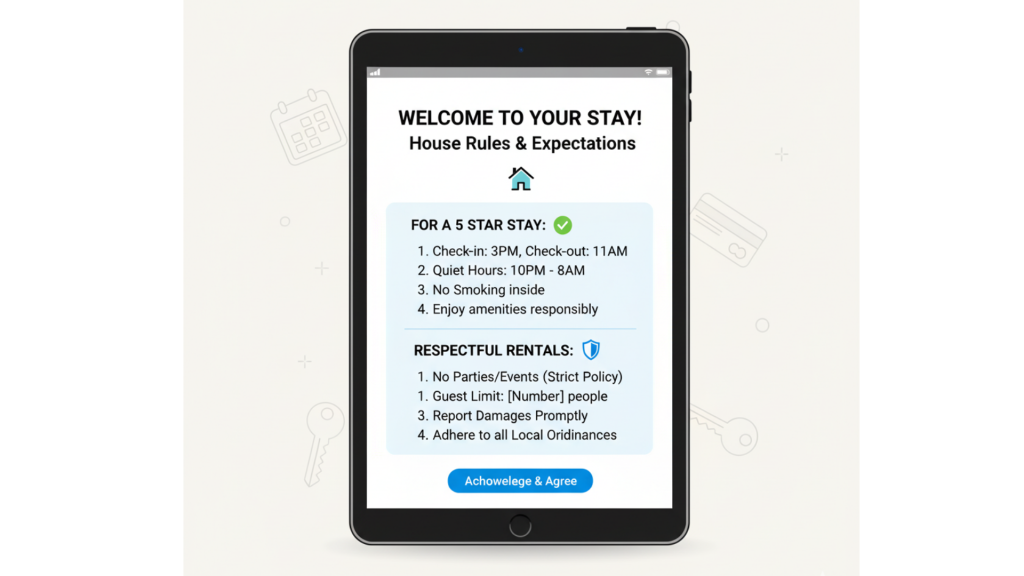
Effective boundaries protect your time by defining when you’re available and what qualifies as urgent. They protect your property by clearly stating usage rules and consequences. Most importantly, they protect your mental health by removing the emotional labor of constant availability. Every boundary you set should exist in writing somewhere guests can reference it, house rules, welcome messages, and listing descriptions all serve as your documentation trail.
Tactic 1 – Screen Guests Before Confirming Bookings
The single most effective strategy for dealing with difficult guests is avoiding them entirely. Guest screening isn’t about discrimination, it’s about assessing compatibility between your property and a guest’s needs. Start with the guest’s booking history and reviews from other hosts. Look for patterns rather than isolated incidents.
Communication during the inquiry phase reveals volumes about what guests expect from vacation rental experiences. Watch for these red flags:
- Requests to bend house rules before booking
- Last-minute booking with unrealistic expectations about preparation time
- Vague or evasive responses about trip purpose or guest count
- Pressure to provide discounts or exceptions to stated policies
Any guest who negotiates boundaries before check-in will continue negotiating throughout their stay. Trust your instincts, if something feels off during the inquiry phase, it probably is.
Tactic 2 – Set Expectations in Every Communication
Most difficult guest situations stem from assumptions rather than malice. Successful hosts eliminate these assumptions through consistent, clear communication at every touchpoint. Your communication strategy should address three phases: pre-arrival, during stay, and post-checkout.
The language you use matters enormously. Instead of “Let me know if you need anything,” say, “I’m available between 9 AM and 9 PM for non-emergency questions, with emergency support for urgent issues like lockouts or flooding.” Instead of the vague “Make yourself at home,” provide specific guidance: “The coffee maker uses pods, which are in the cabinet above.”
Tools like property management software automate this communication cycle while maintaining personalization. Platforms with unified inbox features centralize messages across booking channels, ensuring nothing falls through the cracks when dealing with difficult guests across multiple properties.
Tactic 3 – Respond Professionally, Not Emotionally
When a guest becomes demanding or unreasonable, your emotional response wants to defend, explain, or match their energy. Professional hosts separate their emotions from their response strategy. The key to managing challenging situations effectively is maintaining professional boundaries regardless of how the guest behaves.
Professional responses follow a simple framework: acknowledge the issue, explain your action plan, provide a timeline, and follow through. When the guest complains about the AC “leaking,” your response is: “I understand this is concerning. Based on your description, this sounds like condensation from extended use at the coldest setting. Please adjust to medium temperature. If the issue continues after this adjustment, I’ll arrange for a technician tomorrow morning.”
Create templates for common issues to ensure consistent responses:
- Maintenance: “Thank you for reporting this. I’ll send someone to address it within [timeframe].”
- Noise: “I apologize for the disruption. I’ve contacted [the source], and they’ve agreed to [solution].”
- Missing amenities: “I’m sorry this wasn’t available. I’ll have it delivered within [timeframe] and offer [compensation].”
Some situations require escalation to platform support. Involve them when guests threaten you, demand refunds without valid cause, or violate house rules repeatedly. Document everything before escalating, screenshots, timestamps, and clear policy violations.
Tactic 4 – Document Everything Immediately
The difference between winning and losing a guest dispute often comes down to documentation. Professional property managers document interactions, issues, and resolutions in real time, not from memory later.
Document three categories: guest communications, property condition, and issue resolution steps. All guest messages should flow through platform messaging systems or email—never rely solely on phone calls. Take timestamped photos of property conditions at check-in and checkout, plus any damages or issues during the stay.
When dealing with difficult guests who later leave negative reviews or file complaints, your documentation tells the complete story. Property management systems with built-in documentation features streamline this process. Rather than juggling spreadsheets and photo folders, centralized platforms track all communication, maintenance requests, and guest interactions automatically.
Tactic 5 – Know When to Part Ways
Some guests aren’t worth the revenue they generate. Knowing when to cancel a booking, offer early checkout, or decline future reservations separates profitable hosting from burnout. The cost of one nightmare guest extends beyond that single booking, it affects your mental health, your property condition, and your capacity to serve good guests.
Three scenarios warrant parting ways: pre-booking cancellation when red flags appear during inquiry, mid-stay early checkout when guests violate major house rules or become abusive, and blocking future bookings from guests who caused significant issues.
For mid-stay issues, offer early checkout as a mutual solution: “It seems like our property isn’t meeting your expectations. We’re happy to assist with checkout today and help you find alternative accommodations.” This frames it as addressing their dissatisfaction rather than punishment.
Building Long-Term Prevention Systems
The tactics above work reactively for individual challenging situations. Long-term success requires building prevention into your operations. Professional property managers who rarely encounter difficult guests don’t have better luck – they have better systems.
Your prevention system starts with a pricing strategy. Underpricing attracts budget-focused guests more likely to complain about minor issues. Premium pricing attracts guests who prioritize quality and have higher tolerance for minor inconveniences. House rules need annual review and updating based on issues you’ve encountered.
Automation eliminates many common friction points. Automated messages ensure consistent communication without manual effort. Dynamic pricing adjusts rates based on demand. Channel managers prevent double bookings across platforms. Task management systems ensure cleaning and maintenance never get missed. Explore automation tools that match your portfolio size and management style.
💬 What’s your most challenging difficult guest story, and how did you handle it? Every property manager has been there, share your experience with other hosts on Reddit and see how others approach these situations.
Conclusion
Difficult guests will happen regardless of your prevention systems, that’s the reality of vacation rentals. But hosts who set clear boundaries, communicate expectations proactively, and respond professionally turn potential disasters into manageable situations. Implement these five tactics starting today, document everything, and give yourself permission to say no when a guest isn’t the right fit.
FAQs
Q: Can I legally cancel a confirmed booking if I suspect a guest will be difficult?
A: Most platforms allow penalty-free cancellation for legitimate safety or compatibility concerns, but policies vary by platform. Document your concerns with specific evidence like policy violations in messages, and contact platform support before canceling to avoid penalties.
Q: How do I respond to a negative review from a difficult guest without sounding defensive?
A: Keep your response factual, brief, and under 100 words, state what happened objectively without emotional language or blame. Your response is for future guests to see your professionalism, not to convince the reviewer they were wrong.
Q: What’s the difference between setting boundaries and providing poor guest service?
A: Boundaries define your service standards clearly upfront (availability hours, response times, and emergency protocols), while poor service fails to meet your stated standards. Guest expectations for vacation rental service improve when boundaries are transparent and consistently honored.
Q: Should I offer compensation or refunds when dealing with difficult guests who complain?
A: Offer compensation only when you’ve genuinely failed to meet your stated standards, cleanliness issues, broken amenities, or legitimate maintenance problems. Don’t compensate for guest misunderstandings, unrealistic expectations, or issues beyond your control like weather or neighborhood noise.
Q: How do I mentally recover after hosting a particularly challenging guest?
A: Take a break between bookings to decompress, then review what you could control versus what you couldn’t, most difficult situations stem from expectations mismatches. Update your systems based on lessons learned and connect with other property managers through communities for perspective.

Welcome to Tokeet’s Podcast — your trusted source for insights, trends, and strategies shaping the vacation rental industry. Each episode features expert interviews, data-driven analysis, and practical tips to help property managers grow their businesses, improve guest experiences, and stay ahead in a rapidly evolving market. Whether you’re new to short-term rentals or managing a large portfolio, tune in to stay informed and inspired.
Some days just don’t work for a guest arrival, whether it’s a holiday, a maintenance window, or a turnover day your team can’t cover. This episode walks through check-in and check-out restrictions, the most requested feature in AdvanceCM, now live in the Rentals module. You’ll hear how to block arrivals or departures for a date range, such as December 24 to 26, and how to allow check-ins only on the weekdays you choose. We also cover channel-specific rules, like keeping Airbnb to Friday and Saturday arrivals while direct bookings stay open through Sunday. Finally, we explain what to check before switching rules on, from existing reservations to sync time and visibility on booking sites.
Key Takeaways:
✅ Block check-ins or check-outs for any date range
✅ Limit arrivals to the weekdays you choose
✅ Set different rules for each booking channel
✅ Existing reservations stay unchanged
✅ More restrictions mean fewer guests can book, so review rules each season
Related Links:
Company: https://www.tokeet.com/Blogs: https://www.tokeet.com/blog/Blog: Check-in and Check-out Restrictions: How to Set Them in AdvanceCM 👉 https://blog.tokeet.com/check-in-and-check-out-restrictions/
This is a public episode. If you would like to discuss this with other subscribers or get access to bonus episodes, visit podcast.tokeet.com