

Unfair guest reviews feel worse than normal bad feedback. You enforce house rules, fix issues fast, and still wake up to a comment that twists what really happened and drags down your rating.
You can’t stop unfair guest reviews completely, but you can control how visible the damage is.
This guide walks through seven simple rules to answer them calmly, protect your listing, and show future guests you handle problems like a pro.
If you’re already tired of rewriting replies from scratch, you can turn these rules into templates in a unified inbox so every unfair review gets a consistent, calm response.
Why Unfair Guest Reviews Hurt More Than You Think
Not every negative review is a problem. Unfair guest reviews are the ones that punish you for enforcing rules, blame you for things outside your control, or leave out key context that would change how a reader sees the stay.
They hit you twice. First, emotionally. Second, in the numbers: even a single harsh review can pull down an otherwise strong average rating and push your listing lower in search. On platforms like Airbnb, reviews almost never disappear unless they clearly break content or retaliation rules, so your public response becomes the main story future guests see.
Travel outlets like Travel + Leisure regularly highlight how heavily travelers rely on recent reviews when comparing similar stays. That means one unfair guest review can carry more weight than you’d like, especially if you don’t respond or let it sit without context.
Before vs. After: Response Tone
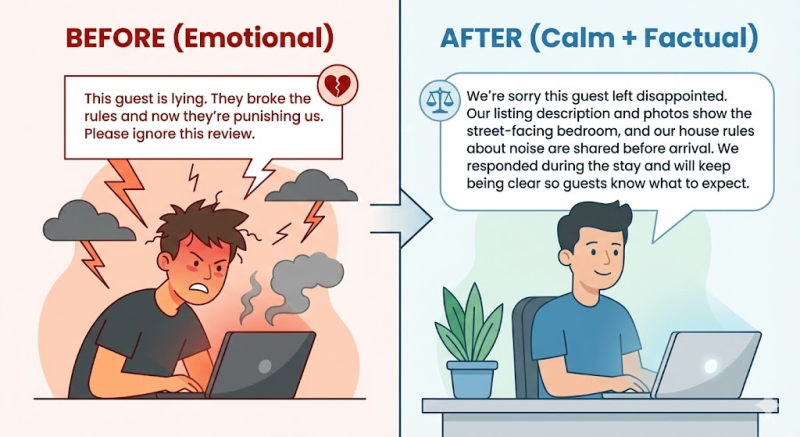
Before vs. After: emotional versus calm, factual responses to unfair guest reviews.
7 Rules for Responding to Unfair Guest Reviews
Use these seven rules as your repeatable playbook for dealing with unfair guest reviews.
1. Don’t reply in the first five minutes
The worst replies are written while you’re still angry. Step away, wait at least 15–30 minutes, and come back when your heart rate is normal. Your response isn’t for the guest, it’s for every future guest who reads it later.
2. Separate facts from frustration
Open the reservation, message history, house rules, and listing photos. Mark which statements are accurate, which are missing context, and which are simply wrong. This turns “this is unfair” into a short list of specific points you might correct in one or two sentences.
3. Decide if a reply actually helps
You don’t have to respond to every unfair guest review. Ask:
- Will future guests be confused if I say nothing?
- Is the reviewer clearly unreasonable in a way readers will pick up without my input?
If the review is obviously wild and your overall profile is strong, letting it sit can be better than giving it more attention. Save your energy for comments where a short reply adds clarity.
4. Open neutral, not defensive
If you do reply, start with a calm opener:
- “Thank you for the feedback.”
- “We’re sorry to hear you felt this way.”
- “We appreciate you sharing your experience.”
This doesn’t admit fault. It simply signals that you listen and respond like an adult, even to unfair guest reviews.
5. Correct key facts—briefly
Pick the one to three points that matter most to future guests and correct them in plain, neutral language:
- “The bedroom faces the main street, which is mentioned in the listing, and we provide earplugs for light sleepers.”
- “Our check-out time is 11 a.m., as shown in the listing and pre-arrival messages.”
Don’t explain every detail. The goal is a quick, factual note that helps readers understand what actually happened.
If the review is tied to threats (“give me a refund or I’ll leave a bad review”), pair your reply with a report to the platform and follow the steps from your guide on how to respond when guests threaten you.
6. Show how you handled it or improved it
Close by showing either how you tried to solve the issue during the stay or what changed afterward:
- “Our team offered to send maintenance during the stay, but this was declined.”
- “We’ve added clearer notes in the listing about the older building’s water pressure.”
You’re showing you care and take action without exposing private guest details.
7. Keep it short and move on
Aim for one short paragraph, maybe two. Long, emotional replies usually look worse than the original comment. After you post, don’t jump back into a public back-and-forth. Your best response to unfair guest reviews after that is fresh, accurate feedback from new guests.
When these rules are saved as templates, anyone on your team can answer unfair guest reviews in under a minute with less risk of emotional replies.
If you’re ready to turn this into a workflow, you can set up those templates and assignments inside the AdvanceCM unified inbox so every review is tagged, answered, and closed out in one place.
Turn Unfair Guest Reviews into Rare Outliers
You don’t need new tools to start, just fix the edge cases first. Once your wording is under control, the next step is to stop replies from slipping through the cracks.
Without a system, reviews live in different inboxes, multiple people reply in different tones, and no one has a clear view of what’s been handled. With a unified inbox, everything sits in one queue: new messages, public reviews, and tasks. In AdvanceCM, you can tag a review as “unfair,” attach internal notes, and use a saved reply template that follows the rules above, then assign it to a team member if needed.
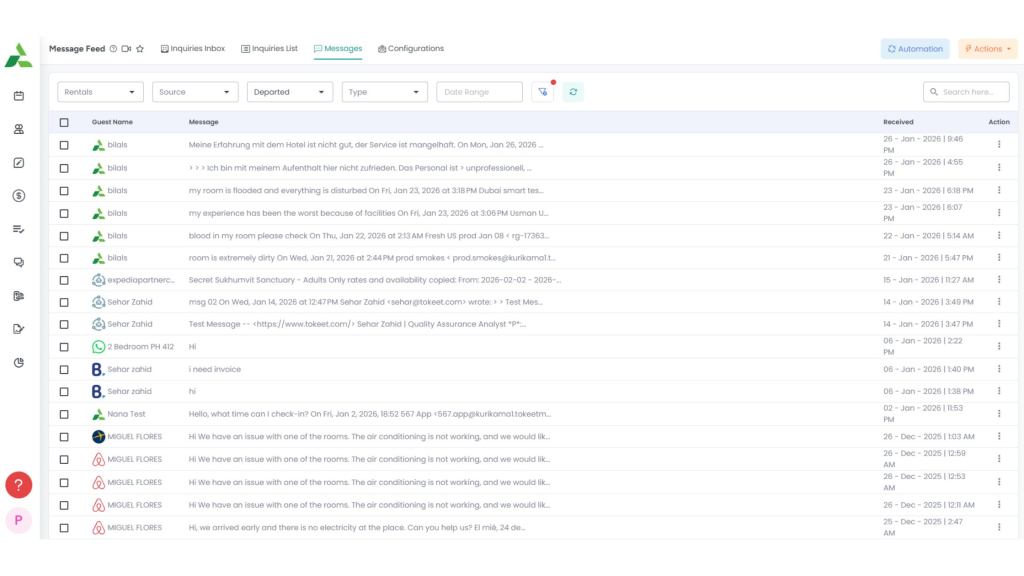
Handle unfair guest reviews from one place: the AdvanceCM Unified Inbox keeps all guest messages in a single view.
The result is structural, not just emotional: fewer late replies, fewer off-brand answers, and a consistent voice that future guests see across all your unfair guest reviews.
When to Escalate an Unfair Guest Review to the Platform
Some unfair guest reviews don’t just bend the truth—they break platform rules.
Most platforms only consider removal when a review clearly violates their policies: hate speech, threats, harassment, extortion (“refund or I’ll leave a bad review”), or irrelevant content that has nothing to do with the stay. For those cases, move from “reply” to “report.”
Basic process:
- Collect evidence
Save screenshots of messages, timestamps, reservation details, and any proof that you enforced clear rules. - Report through the official channel
Use the built-in “report” or “request removal” button instead of a random email. Be brief and factual: which policy you think it breaks, and why. - Stay realistic
Platforms rarely delete comments just because they feel unfair or harsh. Assume most unfair guest reviews will stay and treat removal as a bonus, not a plan.
For more on patterns that feel unfair but usually won’t be removed, see this explainer on why so many negative guest reviews are unfair.
Preventing Unfair Guest Reviews Before They Happen
You can’t block every unfair comment, but you can make them rare and obvious outliers.
Set expectations upfront.
Show reality in your listing: street noise, stairs, older building quirks, farm animals, nightlife nearby. When guests can see it in photos and text before booking, complaints about those things look weaker.
Repeat key rules in messages.
Don’t assume guests read the whole listing. Use short pre-arrival templates to repeat parking rules, quiet hours, visitor limits, and anything that often triggers unfair guest reviews.
Check in during the stay.
A simple “How’s everything going?” The message gives guests a chance to speak up privately. Many issues can be fixed in 10 minutes if you hear about them before check-out.
Psychologists call this “negativity bias” — we react more strongly to bad experiences than good ones. As Psychology Today explains, negative feedback tends to weigh more heavily in people’s decisions, which is exactly why calming unfair guest reviews and collecting more accurate ones matters so much.
Ask for honest, balanced reviews.
After check-out, thank guests and invite them to share what stood out. You can’t ask for only five stars, but you can build a strong base of accurate reviews that make occasional unfair guest reviews look clearly off. For more ideas that boost review quality, see these vacation rental tips to delight guests and earn better reviews.
Conclusion
You’ll never avoid unfair guest reviews completely. But you can decide how you respond, how visible the damage is, and how quickly that review becomes just one odd comment in a long list of accurate feedback.
Follow the seven rules: don’t reply in anger, check facts, decide if a response helps, stay neutral, correct only what matters, show how you handled it, and then move on. Over time, that’s how you protect your rating, keep your listing attractive, and make unfair guest reviews look like rare exceptions instead of your normal guest experience.
If you’d rather not reinvent your reply every time, you can plug this playbook into the AdvanceCM unified inbox and let your team respond in a few clicks with the same calm, host-protecting script.
FAQs
- What counts as an unfair guest review vs. just a negative one?
A negative review can still be fair if it describes real problems you need to fix. Unfair guest reviews usually twist facts, ignore clear rules, or leave out key context in a way that misleads future guests. - Should I ever ignore an unfair guest review and not respond?
Yes, sometimes. If the review is obviously unreasonable and your overall profile is strong, readers can often see that for themselves, and a reply may not add value. - Can one unfair guest review really hurt my booking rate?
It can sting in the short term, especially if you have only a few reviews. Over time, a steady flow of recent positive reviews and a calm response matter far more than one bad comment does. - Can I ask the platform to delete an unfair guest review?
You can usually request removal when a review breaks content or anti-extortion policies, but deletion is never guaranteed. The safer plan is to assume the review will stay and focus on your public reply. - How can I stop unfair guest reviews from piling up?
Set clear expectations in your listing, repeat key rules in messages, check in during the stay, and ask for honest reviews after check-out. Those steps reduce surprises and make any unfair guest reviews that slip through look like clear outliers.

Welcome to Tokeet’s Podcast — your trusted source for insights, trends, and strategies shaping the vacation rental industry. Each episode features expert interviews, data-driven analysis, and practical tips to help property managers grow their businesses, improve guest experiences, and stay ahead in a rapidly evolving market. Whether you’re new to short-term rentals or managing a large portfolio, tune in to stay informed and inspired.
Some days just don’t work for a guest arrival, whether it’s a holiday, a maintenance window, or a turnover day your team can’t cover. This episode walks through check-in and check-out restrictions, the most requested feature in AdvanceCM, now live in the Rentals module. You’ll hear how to block arrivals or departures for a date range, such as December 24 to 26, and how to allow check-ins only on the weekdays you choose. We also cover channel-specific rules, like keeping Airbnb to Friday and Saturday arrivals while direct bookings stay open through Sunday. Finally, we explain what to check before switching rules on, from existing reservations to sync time and visibility on booking sites.
Key Takeaways:
✅ Block check-ins or check-outs for any date range
✅ Limit arrivals to the weekdays you choose
✅ Set different rules for each booking channel
✅ Existing reservations stay unchanged
✅ More restrictions mean fewer guests can book, so review rules each season
Related Links:
Company: https://www.tokeet.com/Blogs: https://www.tokeet.com/blog/Blog: Check-in and Check-out Restrictions: How to Set Them in AdvanceCM 👉 https://blog.tokeet.com/check-in-and-check-out-restrictions/
This is a public episode. If you would like to discuss this with other subscribers or get access to bonus episodes, visit podcast.tokeet.com