
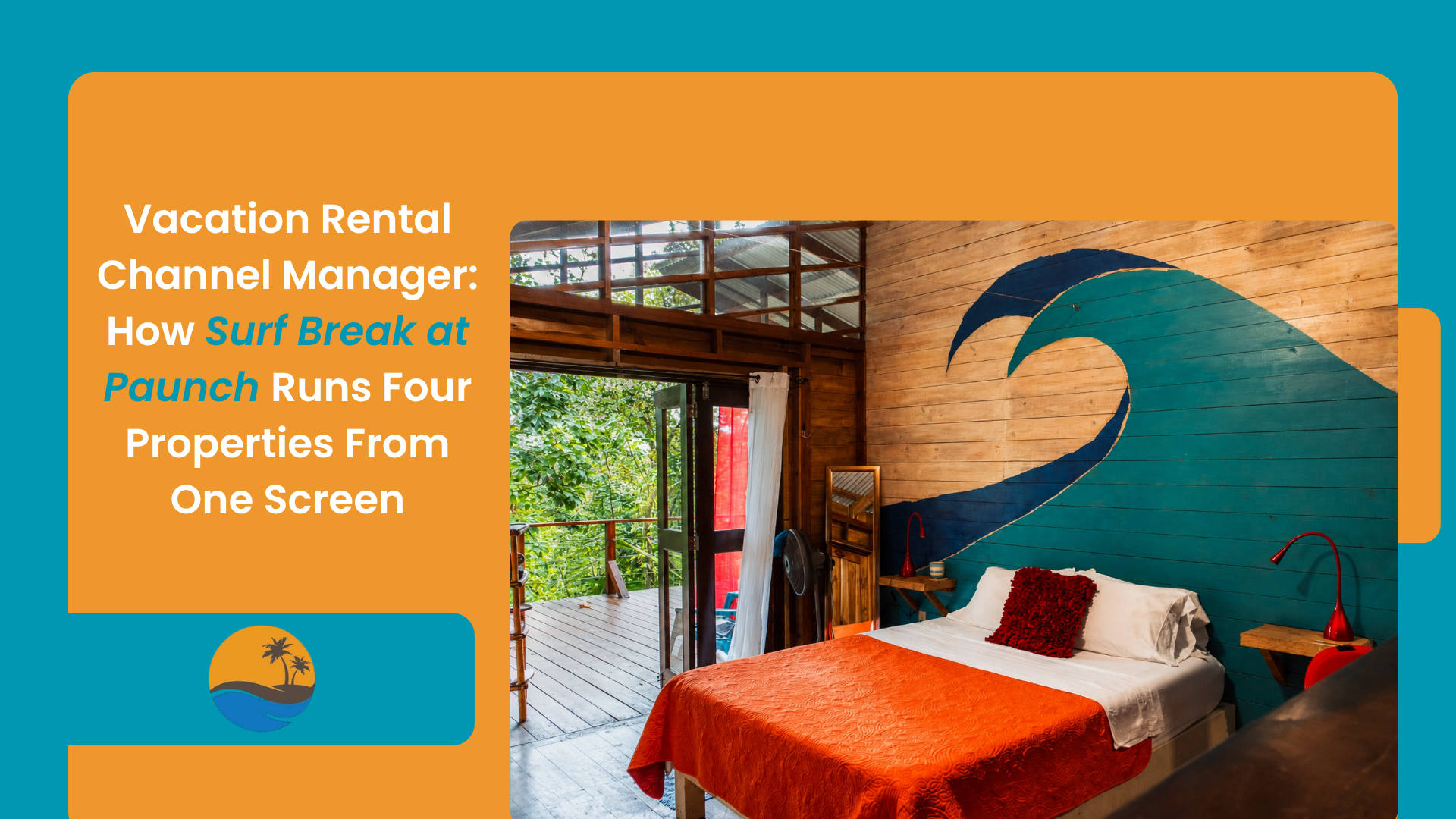
A vacation rental channel manager keeps a property’s availability, rates, and guest messages synced across every booking site it’s listed on, so a reservation on one channel automatically blocks it everywhere else. For David Emerson, who has run Surf Break at Paunch in Bocas del Toro, Panama for 11 years, that sync is what let him stop checking each booking site by hand and start running four properties — soon six — from one screen.
David switched from Tokeet’s original app to AdvanceCM, Tokeet’s vacation rental channel manager, when it launched, and the change reshaped how he handles bookings, rates, and guest replies every day.
A vacation rental channel manager connects a property’s booking engines so availability, rates, and guest messages stay synced everywhere. It blocks the same dates across every channel the moment one books, centralizes guest replies, and simplifies rate updates — removing the manual, error-prone work of managing each booking site separately.

What a Vacation Rental Channel Manager Does for Multi-Property Hosts
Hosts running more than one property, or one property on more than one booking site, run into the same problem: every site needs to agree on the same availability and rates at the same time. Without a system enforcing that, it’s easy to end up with a booking on Airbnb that never gets blocked on Booking.com, or a rate change that only makes it to one of the four rooms it should apply to.
A vacation rental channel manager exists to close that gap. It sits between a property’s booking engines and keeps them synchronized automatically, so the host doesn’t have to manually re-check every channel every time something changes.
The Problem Before a Channel Manager: David’s Original Setup
Before AdvanceCM, David managed Surf Break at Paunch through the original Tokeet app, checking and updating each booking channel largely on its own. Changing rates across multiple rooms was slow, and keeping details consistent across every property took more manual work than he wanted.
“I could change rates for all rooms so much easier [with AdvanceCM],” David said, describing the difference from his old setup. “I could get into details for all rooms. Everything about it was just so much easier.”
Why calendar sync breaks down without a channel manager is a common problem for hosts relying on manual updates or basic platform connections — delayed syncs and internal glitches are exactly the kind of risk a dedicated channel manager is built to remove.
How AdvanceCM’s Channel Manager Changed David’s Day-to-Day
David runs all of his booking engines through AdvanceCM, so a reservation on one channel blocks the same dates everywhere else automatically.
“If I get one booking, it blocks it with everybody else,” he said. “It makes it a lot easier to respond to customers directly through [AdvanceCM] instead of going to each individual booking engine. Everything’s just done right here. I don’t actually ever go to the other search engines or the booking engines.”

That’s the same mechanism Airbnb’s own host guidance points to: syncing your calendars across the sites you list on is what helps you avoid double bookings in the first place. And on the Booking.com side, availability updates made through a connectivity provider — Booking.com’s term for a channel manager — are what keep the Extranet calendar accurate without the host logging in separately. AdvanceCM’s channel manager handles that sync for David across every site he lists on, not just one.
Faster Rate Management, Not Just Faster Bookings
Rate management was the specific pain point that pushed David to switch. “The rate tables are so much easier to change within AdvanceCM than they were on the previous model,” he said. “I kind of struggled with that at first on the original app, and when this came out, it just made it so much easier.”
As a portfolio grows, rate changes stop being a once-in-a-while task and start being something a host has to revisit constantly — seasonal shifts, local events, demand swings. Tokeet’s guide to dynamic pricing for vacation rentals covers why a flat, manually-set rate tends to underprice high-demand nights and overprice slow ones. AdvanceCM’s channel manager doesn’t set prices automatically, but it does make it possible to update rates across every room and every channel from one screen instead of one at a time.
Why Live Chat Support Matters When You’re Running It Yourself
Asked what’s made the biggest difference day to day, David didn’t point to a specific automation. He pointed to the people behind the platform.
“Honestly, the live chat for help — I think that’s the greatest thing there is, because somebody’s almost always on there,” he said. “I get quick responses. They’ve helped me fix or do anything on there as I’m navigating the site.”
For a host managing everything himself, with no dedicated tech team, that kind of responsive support is part of what makes a channel manager usable day to day rather than another system to fight with.
What Other Hosts Should Ask Before Choosing a Vacation Rental Channel Manager
David’s advice to other hosts weighing a channel manager comes down to time, not just features.
“If you’re managing multiple properties and you’re using multiple booking engines, it’s a no-brainer,” he said. “It just makes it so much easier to manage everything. If you incorporate the cost of it, it’s really not that bad. If you’re looking at an hourly rate — how many times are you going back and forth between search engines instead of going straight to one channel manager?”
For hosts comparing options, it’s worth checking which booking sites and tools a given channel manager integrates with before committing — the value of a vacation rental channel manager depends on how many of your actual channels it can keep in sync.
Scaling From Four Properties to Six With the Same System
With a fifth property planned for next year and a sixth on the horizon, David’s workflow will only get more complex — more calendars to block, more channels to keep aligned, more guest messages to answer. Running that through a single vacation rental channel manager, rather than adding a new manual process for every new property, is what’s letting him plan the next two properties without dreading the added admin work.
Why This Story Matters
A vacation rental channel manager doesn’t just prevent double bookings — it changes how much a growing portfolio costs a host in time. David’s story shows what that looks like in practice: rate updates that used to be a struggle, guest replies that used to mean logging into four different sites, and a plan to grow from four properties to six without rebuilding how he works.
Ready to see what a vacation rental channel manager can do for your booking workflow? Explore AdvanceCM’s Channel Manager
FAQs
- What is a vacation rental channel manager?
A vacation rental channel manager is software that connects a property’s listings across booking sites like Airbnb, Booking.com, and Vrbo, keeping availability, rates, and guest messages synced so a booking on one site automatically updates the others. - How does a channel manager prevent double bookings?
It blocks the same dates across every connected channel the moment one of them receives a booking, instead of relying on a host to manually update each site or waiting on a platform’s own sync delay. - Is a vacation rental channel manager worth it for hosts with just a few properties?
David Emerson’s experience managing four properties (with a fifth and sixth planned) suggests yes — the time saved on manual updates and channel-hopping applies even to smaller portfolios, not just large management companies. - What’s the difference between a channel manager and a property management system (PMS)?
A channel manager focuses specifically on syncing availability, rates, and bookings across channels. A full PMS, like AdvanceCM, typically includes a channel manager plus additional tools such as a unified inbox, invoicing, and task management. - How did AdvanceCM help David Emerson at Surf Break at Paunch?
AdvanceCM’s channel manager let David sync all of his booking engines automatically, respond to guests from one place instead of each individual site, and update rate tables faster than his previous setup — all of which he says has made it easier to plan growth from four properties to six.

Welcome to Tokeet’s Podcast — your trusted source for insights, trends, and strategies shaping the vacation rental industry. Each episode features expert interviews, data-driven analysis, and practical tips to help property managers grow their businesses, improve guest experiences, and stay ahead in a rapidly evolving market. Whether you’re new to short-term rentals or managing a large portfolio, tune in to stay informed and inspired.
David Emerson has run SurfBreak at Paunch, a four-property vacation rental business in Bocas del Toro, Panama, for 11 years.
In this episode, he walks through why he switched from Tokeet’s original app to AdvanceCM and what changed in his day-to-day booking management. We cover how AdvanceCM’s channel manager keeps every booking site in sync, so one reservation blocks the same dates everywhere else automatically.
David explains why live chat support has made the biggest difference for him, and how rate table updates became far simpler. He also shares his advice for other hosts weighing a channel manager, and his plan to grow from four properties to six over the next few years.
This is a real host’s account of what changed for his business, not a product pitch.
Key Takeaways:
✅ David switched from Tokeet’s original app to AdvanceCM for easier rate management across rooms and properties
✅ AdvanceCM’s channel manager syncs every booking site automatically, so one reservation blocks the same dates everywhere else
✅ Live chat support is the feature David says has made the biggest difference in his day-to-day
✅ His advice to other multi-property hosts: the time saved outweighs the cost of a channel manager
✅ David plans to grow SurfBreak at Paunch from four properties to six over the next few years
Related Links:
Company: https://www.tokeet.com/Blogs: https://www.tokeet.com/blog/Blog: Vacation Rental Channel Manager: How Surf Break at Paunch Runs Four Properties From One Screen 👉https://blog.tokeet.com/vacation-rental-channel-manager-case-study/
This is a public episode. If you would like to discuss this with other subscribers or get access to bonus episodes, visit podcast.tokeet.com