

Getting penalized for enforcing your own house rules feels absurd. Yet thousands of property managers face this exact situation every month when they decline booking requests that violate their stated policies. One host recently shared their frustration after receiving penalties for rejecting guests who wanted to exceed their property’s maximum occupancy, even though those limits were clearly posted on their listing.
The good news? You don’t have to accept these penalties as the cost of doing business. This guide shows you exactly how to avoid host penalties while maintaining your property standards and protecting your business.
Understanding how to avoid host penalties is crucial for maintaining your property’s performance.
Why Booking Platforms Penalize Hosts
Most major booking platforms use automated systems to rank listings based on performance metrics. These algorithms prioritize hosts who accept a high percentage of booking requests, assuming that more acceptances equal better guest experiences. The problem is that these systems can’t distinguish between rejecting a booking for legitimate reasons versus declining arbitrarily.
Knowing how to avoid host penalties can save you time and resources.
The Ranking Algorithm Problem
Platform algorithms focus on acceptance rates as a key ranking factor, treating all declined requests equally regardless of the reason behind them. A host who accepts 90% of requests typically ranks higher in search results than one who accepts 70%, even if those rejections protected property safety or enforced occupancy limits. This automated approach creates real business consequences for responsible property managers.
By implementing strategies on how to avoid host penalties, you can enhance your business practices.
- Algorithms can’t differentiate between arbitrary rejections and rule enforcement.
- Lower acceptance rates automatically trigger ranking drops
- No human review occurs before penalties are applied.
- Your listing visibility decreases without warning.
Real Impact on Your Business
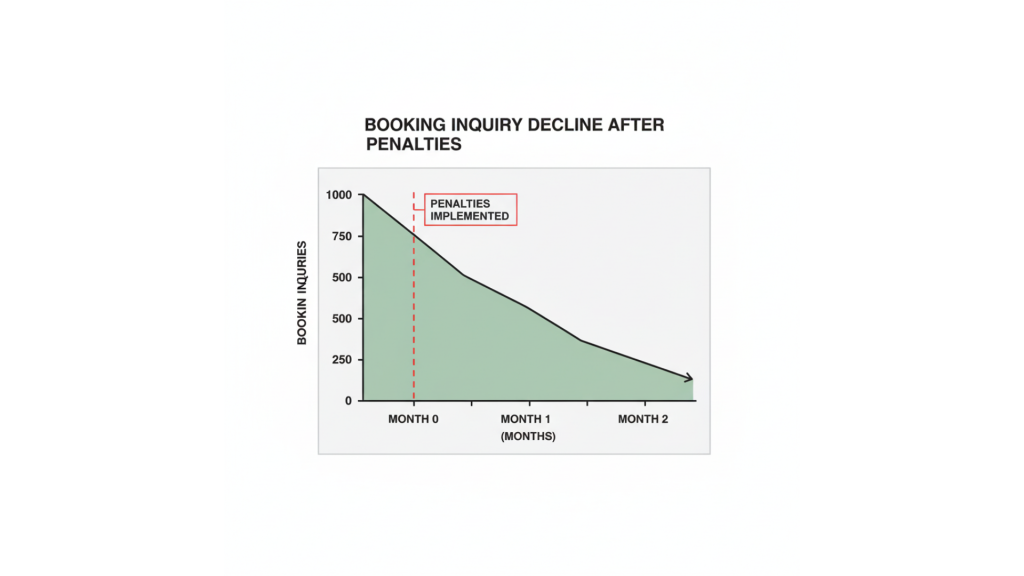
OTA penalties for declining bookings can significantly affect your bottom line through reduced visibility and lost booking opportunities. Lower search rankings mean fewer potential guests see your property, with some hosts reporting inquiry drops of 50-60% after a single penalty. The time cost compounds the financial impact as you spend hours documenting violations and navigating support systems.
Implementing strategies on how to avoid host penalties will lead to better financial outcomes.
- Search ranking drops push listings from page 1 to page 3 or lower.
- Booking inquiries can decline by 50-60% during penalty periods.
- Appeal processes take weeks while your listing stays buried.
- Support outcomes vary wildly with no consistent resolution policy
6 Strategies to Avoid Host Penalties
Rather than waiting for penalties to strike, take proactive steps to protect your listings and business. These strategies reduce your exposure to unfair penalties while maintaining your property standards and guest experience quality.
Learning how to avoid host penalties is one of the first steps in property management.
1. Diversify Across Multiple Booking Channels
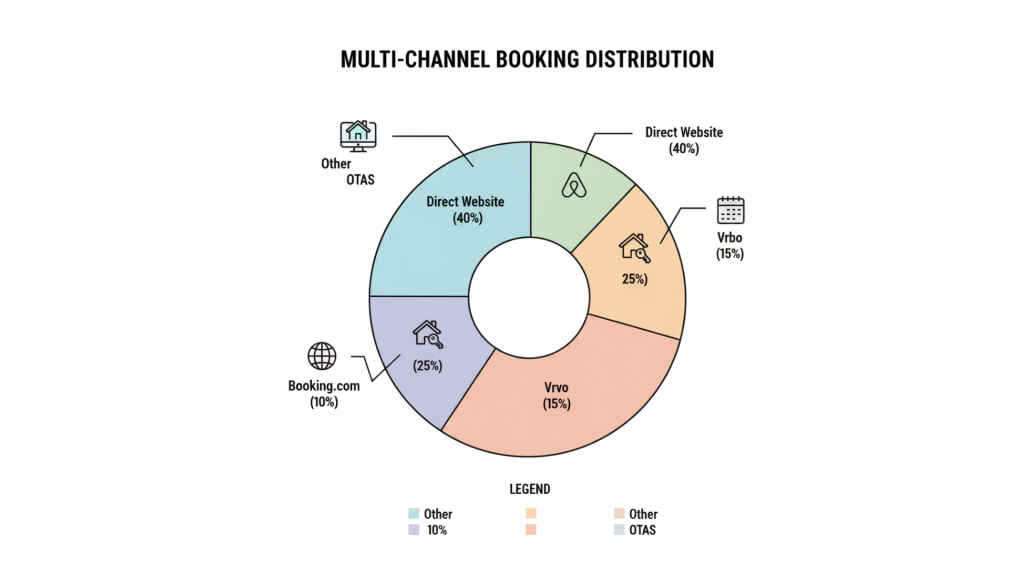
Relying on a single platform puts your entire business at the mercy of one company’s penalty system and algorithmic decisions. Spreading your listings across multiple channels means a penalty on one platform doesn’t tank your entire booking pipeline or revenue stream. Modern technology makes multi-channel management simpler than ever.
- Distribute listings across 10-20 different booking platforms
- One platform’s penalty doesn’t affect your other channel rankings.
- Reach different guest demographics on different platforms
- Channel management tools synchronize calendars across 50+ platforms in real time
2. Build Your Direct Booking Website
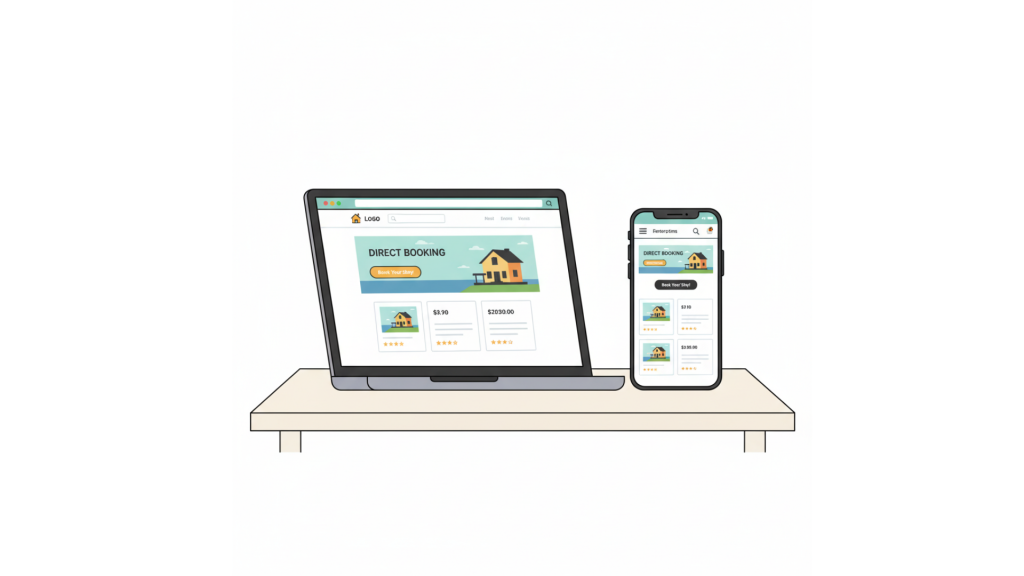
Creating your own booking website eliminates platform penalties entirely while putting you in complete control of policies and guest relationships. You set the rules, control the guest experience, and keep 100% of the booking value instead of paying 15-20% commissions to third parties. Direct bookings represent the ultimate protection against arbitrary platform penalties.
- No risk of penalties for enforcing your own policies
- Direct bookings offer a solution on how to avoid host penalties effectively.
- Zero commission fees on direct bookings
- Complete control over house rules and booking terms
- Purpose-built website builders include booking engines and payment processing
3. Automate Guest Pre-Screening
Many penalty-triggering situations arise from miscommunication about house rules before guests submit booking requests. Automated pre-booking messages that clearly explain occupancy limits, pet policies, and other key requirements help incompatible guests self-select out before creating situations where you must decline. Prevention beats damage control every time.
Automating guest communication helps in knowing how to avoid host penalties.
- Set up automated inquiry responses explaining key policies
- Use automated messaging to answer common questions instantly.
- Clear communication reduces incompatible booking requests.
- Guests who understand requirements upfront rarely violate them.
4. Use Pre-Approval Instead of Instant Book
Instant booking might seem convenient, but it increases penalty risk by removing your ability to screen requests before confirmation. Pre-approval settings let you review each request, communicate with potential guests, and clarify requirements before accepting. This extra step prevents problematic bookings while protecting your acceptance rate from rule-violating requests.
Understanding the importance of pre-approval settings is essential in learning how to avoid host penalties.
- Review guest count and requirements before confirming
- Communicate directly about house rules and expectations
- Decline incompatible requests before they become penalty-generating rejections
- Slight reduction in spontaneous bookings outweighed by penalty protection
5. Document Everything
When you must decline a booking request due to policy violations, documentation becomes your best defense during the appeals process. Screenshot the booking request showing the guest’s stated party size, dates, or other details that violate your clearly posted rules. Save copies of your house rules exactly as they appeared at the time of the request.
Documentation plays a key role in how to avoid host penalties effectively.
- Screenshot booking requests showing policy violations
- Save your house rules documentation with timestamps.
- Keep all guest communication about requirements
- Evidence significantly improves penalty appeal success rates
6. Monitor Your Performance Metrics
Check your performance dashboard weekly across all platforms where you list properties. Track your acceptance rates, response times, and any new penalties or warnings that appear. Catching issues early lets you adjust your communication approach or listing strategy before problems compound into serious ranking drops.
Keeping track of your performance metrics is vital in understanding how to avoid host penalties.
- Review metrics on all platforms weekly
- Track acceptance rate trends over time
- Identify patterns in declined requests
- Adjust house rule communication if needed
How Multi-Channel Management Protects You
Platform independence acts as insurance against penalty systems and algorithmic changes beyond your control. When you distribute your listings across multiple channels, one platform’s penalty doesn’t cripple your business or force you to compromise your property standards. You maintain visibility with guests across different demographics, geographic regions, and booking preferences simultaneously.
Professional property management systems handle 50+ channels from a single dashboard, automatically syncing calendars, rates, and availability across all platforms. This level of diversification means even if two or three platforms penalize you simultaneously, you’ve still got dozens of other booking sources generating revenue.
Using multi-channel management systems will equip you with knowledge on how to avoid host penalties.
According to the Vacation Rental Management Association, property managers using multi-channel strategies report 35% higher occupancy rates than those relying on single platforms. That diversification also provides negotiating leverage, when platforms know they’re not your only option, their policies impact you less severely.
What to Do If You’re Already Penalized
Already dealing with a penalty on your account? Don’t panic or assume the situation is permanent. While the appeals process can be frustrating and inconsistent, successful resolution is possible with the right approach and proper documentation.
Document the Rule Violation
Gather all evidence showing the guest’s request violated your clearly stated policies that were visible at the time of their inquiry. This includes screenshots of the booking request details, your house rules as they appeared on your listing, and any communication with the guest about requirements. The more comprehensive your documentation, the stronger your appeal case becomes.
Gathering evidence helps clarify how to avoid host penalties in future situations.
- Screenshot the booking request showing policy violations
- Capture your house rules exactly as displayed to the guest
- Save any messages discussing requirements or limitations.
- Compile everything into a clear, organized appeal package
Contact Support Strategically
Call customer support rather than relying on email when possible, as phone conversations often reach more experienced agents who have authority to remove penalties.
Understanding support processes can give insight into how to avoid host penalties.
Reference the specific policy that was violated and provide your documentation upfront. Understanding platform host policies can help you frame your appeal more effectively.
Be persistent but professional, sometimes resolution requires multiple attempts with different representatives.
- Call support instead of emailing for faster resolution
- Reference specific policies violated by the guest request
- Provide documentation immediately when asked
- Politely escalate to supervisors if the first agent can’t help.
Being prepared is essential for how to avoid host penalties during support interactions.
Reduce Platform Dependency Going Forward
Use this penalty as motivation to diversify your booking sources and reduce vulnerability to future algorithmic decisions. Start building alternative channels now so you’re less exposed to any single platform’s penalty system. Research pricing options for systems that can manage multiple channels without creating overwhelming operational complexity.
- Begin listing on 5-10 additional platforms immediately
- Start building a direct booking website
- Set up automated guest communication to prevent future issues
- Create a multi-channel strategy that protects against future penalties
Strategizing on how to avoid host penalties will enhance your overall property management.
💬Join the conversation with other property managers sharing their experiences and solutions on Reddit.
Conclusion
In conclusion, understanding how to avoid host penalties is crucial for your success.
Platform penalties for enforcing legitimate house rules represent a systemic flaw in how booking channels measure host performance. But you don’t have to accept these penalties as inevitable or let them control your business decisions. By diversifying your booking channels, automating guest communication, and maintaining proper documentation, you protect your business from arbitrary ranking drops while upholding your property standards.
The hosts who thrive long-term aren’t those who compromise their rules to avoid penalties, they’re the ones who build platform-independent businesses that can’t be controlled by any single company’s algorithm. Start taking those steps today, and you’ll spend less time fighting penalties and more time focusing on what actually matters: delivering great guest experiences and growing your rental business.
Investing time in learning how to avoid host penalties will pay off in the long run.
FAQs
Q: Can I appeal a host penalty after it’s been applied?
A: Yes, most platforms allow appeals, though success rates vary. Document the rule violation that prompted your rejection and contact support with clear evidence. Call rather than email for better results, and be prepared to escalate to supervisors if needed.
It is vital to know how to avoid host penalties when appealing decisions.
Q: How long do host penalties typically affect my listing?
A: Penalty duration varies by platform, typically lasting 30-90 days. Some platforms use rolling metrics that improve as you accept more bookings, while others apply fixed-term penalties regardless of subsequent performance.
Q: Will using multiple booking channels cause double bookings?
A: Not when using proper channel management tools that synchronize calendars in real time. When a booking is confirmed on one platform, all connected channels update within seconds, preventing conflicts.
Proper strategies on how to avoid host penalties will maximize your listing potential.
Q: Should I turn off instant booking to avoid penalties?
A: Pre-approval settings reduce penalty risk by letting you review requests before confirming. While you may receive fewer spontaneous bookings, the trade-off protects you from accepting problematic reservations or declining requests that trigger penalties.
Q: How many booking channels should I list?
A: Start with 5-10 major platforms that serve your target market. As you become comfortable managing multiple channels, expand to 15-20 to maximize exposure. The key is using tools that make multi-channel management sustainable without overwhelming your operations.
Lastly, learning how to avoid host penalties will protect your business from unforeseen challenges.

Welcome to Tokeet’s Podcast — your trusted source for insights, trends, and strategies shaping the vacation rental industry. Each episode features expert interviews, data-driven analysis, and practical tips to help property managers grow their businesses, improve guest experiences, and stay ahead in a rapidly evolving market. Whether you’re new to short-term rentals or managing a large portfolio, tune in to stay informed and inspired.
Some days just don’t work for a guest arrival, whether it’s a holiday, a maintenance window, or a turnover day your team can’t cover. This episode walks through check-in and check-out restrictions, the most requested feature in AdvanceCM, now live in the Rentals module. You’ll hear how to block arrivals or departures for a date range, such as December 24 to 26, and how to allow check-ins only on the weekdays you choose. We also cover channel-specific rules, like keeping Airbnb to Friday and Saturday arrivals while direct bookings stay open through Sunday. Finally, we explain what to check before switching rules on, from existing reservations to sync time and visibility on booking sites.
Key Takeaways:
✅ Block check-ins or check-outs for any date range
✅ Limit arrivals to the weekdays you choose
✅ Set different rules for each booking channel
✅ Existing reservations stay unchanged
✅ More restrictions mean fewer guests can book, so review rules each season
Related Links:
Company: https://www.tokeet.com/Blogs: https://www.tokeet.com/blog/Blog: Check-in and Check-out Restrictions: How to Set Them in AdvanceCM 👉 https://blog.tokeet.com/check-in-and-check-out-restrictions/
This is a public episode. If you would like to discuss this with other subscribers or get access to bonus episodes, visit podcast.tokeet.com