
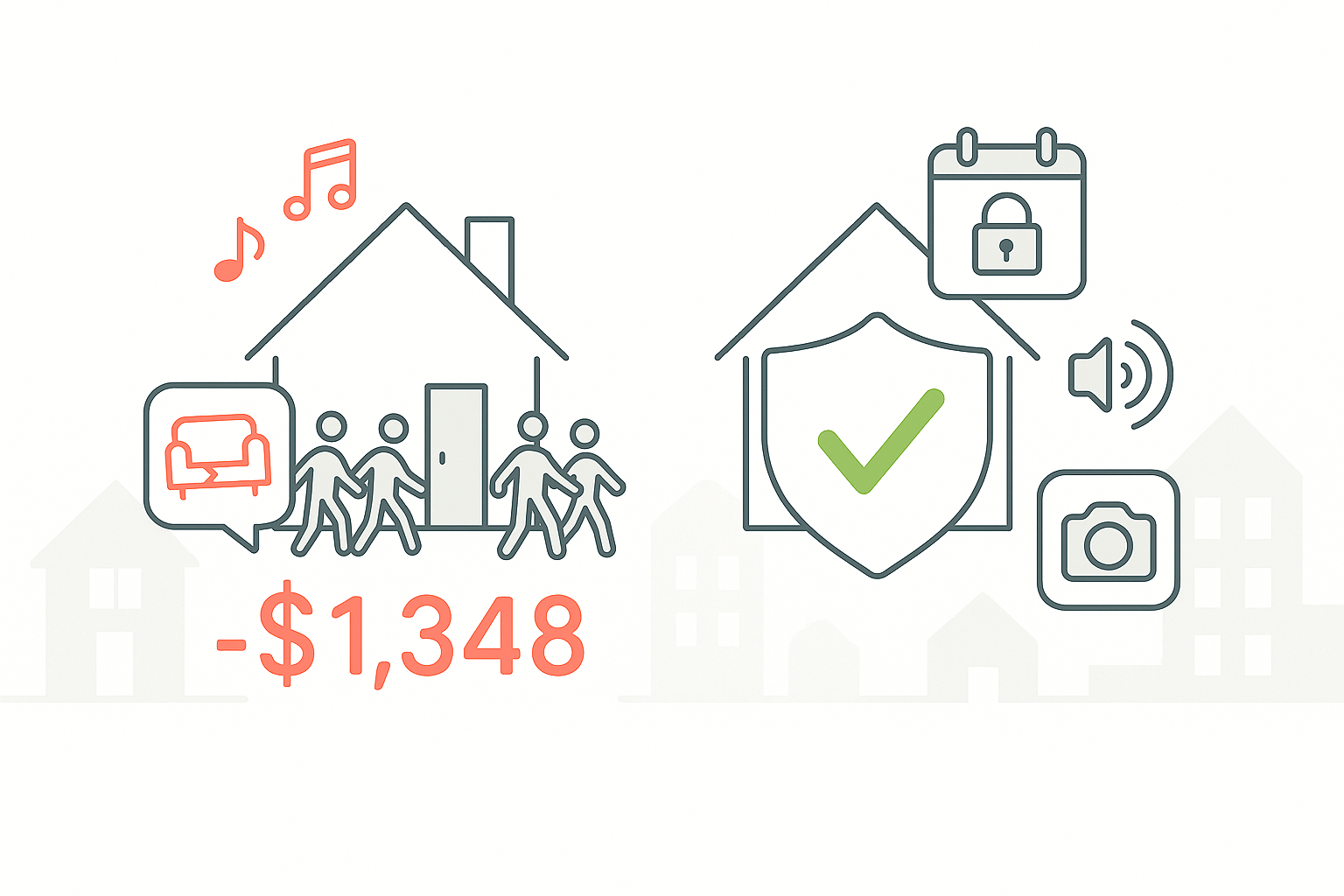
Party prevention isn’t just a policy issue for vacation rental managers, it’s a financial survival strategy. One experienced Airbnb host learned this lesson the hard way when a seemingly innocent one-night booking turned into a 30-guest unauthorized party, resulting in $1,348 in damages, suspected illegal activity, and a same-day scramble to prepare for the next guest.
This isn’t a cautionary tale about inexperienced hosts making rookie mistakes. This happened to a property manager with nearly four years of hosting experience who had one simple rule: never accept one-night bookings from local residents. Until she broke it.
The 5 AM Wake-Up Call That Changed Everything
The phone rang at 5 AM. Fed-up neighbors reported an ongoing party at the vacation rental property. By the time the host arrived, 14 people were still inside the small apartment. Security camera footage would later reveal over 30 unique individuals had entered and exited throughout the night.
The booking request had come from a local resident on August 1st. The guest claimed her sister was visiting with three children, and her small urban apartment couldn’t accommodate everyone. The story was polished, sympathetic, and completely fabricated.
The host had adjusted her booking settings after an “Airbnb Host Success Manager” suggested her minimum-stay requirements were hurting her search ranking. She allowed one-night gap bookings through her dynamic pricing tool. That single policy change opened the door to disaster.
What Actually Happened: 30+ Guests, One Lie
The Setup: A “Polished” Story
The guest’s narrative hit all the right notes. A visiting sister. Three young children. A too-small apartment. Family togetherness. The booking showed five people: the guest, her sister, and three kids.
Property managers face this challenge constantly. Some stories are genuine. Some are sophisticated lies designed to bypass security measures. The difference isn’t always obvious, even to experienced hosts.
Looking back, the red flags were there. A local resident. One night. Last-minute timing. But confirmation bias is powerful when a story triggers empathy.
The Reality: Evidence from 120 Video Clips
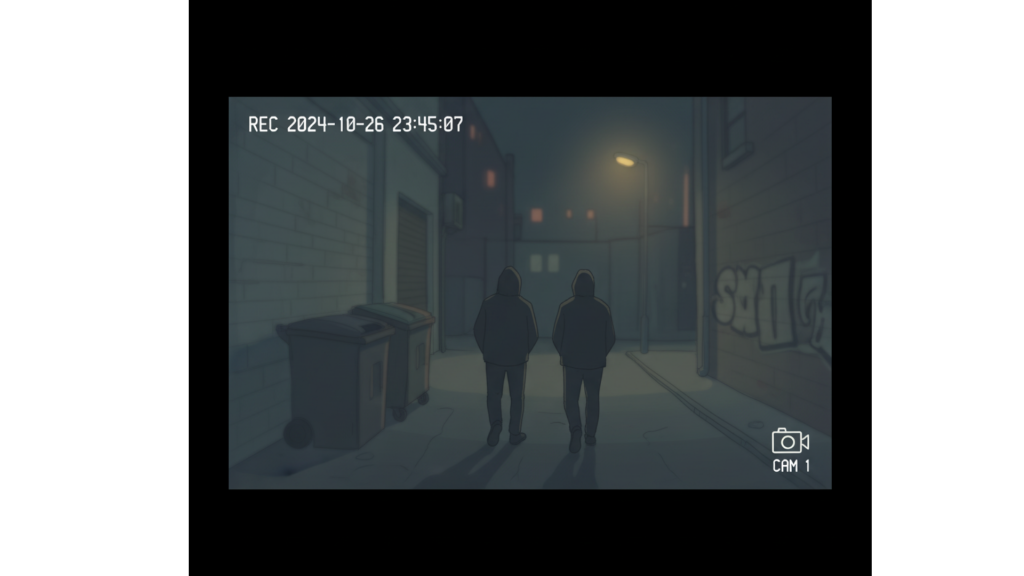
The host maintains multiple security cameras on the property, including a backup camera placed higher up after local police recommended redundant systems to prevent porch theft. When guests attempted to disable the primary doorbell camera by covering it, they didn’t notice the second device.
The 120 video clips revealed:
- Over 30 distinct individuals documented
- Cars constantly circling the building
- Continuous deliveries throughout the night
- At one point, young women in black lingerie exiting the unit
- Men arriving and leaving for brief periods
- The actual booker present for only 20-25 minutes total
The pattern suggested more than just an unauthorized party. Commenters and the Airbnb safety team noted the activity indicated a potential “pop-up brothel”, organized prostitution operations that increasingly target vacation rentals. The host filed a police report and scheduled a follow-up with Airbnb’s safety team.
The True Cost of Unauthorized Parties
The financial damage was immediate and substantial:
- Emergency deep cleaning: $598
- Sofa bed replacement: $750
- Ruined linens and cleanup: Additional unclaimed costs
- Total documented claim: $1,348
But the real cost extended far beyond money. The next guest, a woman arriving with her children for her mother’s funeral, was scheduled to check in at 3 PM the same day. The host had less than 10 hours to evict remaining partygoers, replace furniture, and make the unit “spotless.”
Research from the Vacation Rental Management Association shows unauthorized parties remain one of the top security concerns for property managers, with average damages ranging from $1,000 to $5,000 per incident.
Compare those figures to the cost of robust party prevention systems. Property management platforms like AdvanceCM start at $19.99 per property monthly for smaller portfolios, scaling down to $2.39 per property for larger operations with 300+ rentals. One prevented party pays for years of prevention tools.
The host succeeded in the turnaround, even stocking the unit with flowers, milk, juice, and frozen pizzas for the grieving family. But the experience was exhausting, expensive, and completely preventable.
The Red Flags Every Property Manager Should Know
High-Risk Booking Indicators
Party prevention starts with recognizing patterns. These booking characteristics warrant extra scrutiny:
- Local bookings: Guests from the same city rarely need overnight accommodation.
- One-night stays: Short bookings limit accountability and detection time.
- Last-minute requests: Legitimate travelers typically book in advance.
- Vague explanations: Overly detailed or suspiciously simple stories
- Young guests: Age alone isn’t disqualifying, but combined with other factors, it increases risk.
- New accounts: Profiles without reviews or history
- Communication style: Pushback on house rules or ID verification
The property manager in this case violated her own number-one rule: no one-night local bookings. Experience had taught her this was the highest-risk category. But platform pressure to increase bookings and improve search ranking led to a costly exception.
Why Manual Screening Fails
Humans excel at empathy. That’s also why we’re vulnerable to manipulation. We want to believe sympathetic stories. We second-guess our instincts when someone seems genuine.
Manual screening also doesn’t scale. Reviewing every booking request thoroughly takes time property managers don’t have. As portfolios grow from 5 to 50 to 500 properties, human-only vetting becomes impossible.
The solution isn’t eliminating human judgment. It’s augmenting it with technology that never gets tired, never experiences confirmation bias, and can analyze patterns across thousands of bookings simultaneously.
How AI Vacation Rental Automation Changes Party Prevention
Traditional property management relies on rigid rules: no locals, minimum three-night stays, and no guests under 25. But blanket policies cost revenue and alienate legitimate guests.
AI vacation rental automation takes a different approach. Instead of blocking categories entirely, systems like those offered by AdvanceCM’s Autopilot analyze multiple risk factors simultaneously to generate real-time risk scores.
Automated Risk Detection
Modern platforms monitor:
- Booking timing patterns (last-minute, odd hours)
- Guest communication style and content
- Historical data from similar bookings
- Cross-platform review analysis
- Behavioral pattern matching
When multiple risk factors align, local booking + one night + new account + vague story, the system flags it for manual review or automatic rejection based on your settings.
Smart Device Integration
Party prevention doesn’t end at booking acceptance. Real-time monitoring catches problems as they develop.
Smart device integration enables:
- Automated door activity alerts (unusual foot traffic)
- Decibel monitoring without privacy violations
- Pattern detection (constant ins and outs)
- Instant notification systems
- Video evidence compilation for claims
According to research from Cornell University, properties using integrated monitoring systems experience 73% fewer unauthorized party incidents compared to those relying solely on reactive measures.
The host in this incident had cameras, but reviewing 120 clips manually was exhausting. Automated systems flag unusual activity in real-time, enabling intervention before thousands in damages occur.
The 24-Hour Recovery Protocol
The host faced an impossible timeline. At 5 AM, 14 people were still in her unit. At 3 PM, a grieving mother and her children would arrive expecting a spotless, welcoming space.
She executed a rapid response protocol:
- Immediate eviction of remaining guests (5:00-6:00 AM)
- Damage documentation with photos and video (6:00-7:00 AM)
- Emergency cleaning crew dispatch (7:00 AM)
- Furniture replacement from personal home (8:00-10:00 AM)
- Deep cleaning completion (10:00 AM-2:00 PM)
- Guest-ready inspection and compassionate extras (2:00-3:00 PM)
This kind of coordinated response requires either an on-call team or exceptional personal sacrifice. Most property managers can’t drop everything for same-day crisis management.
Automated task management systems streamline emergency protocols. When a party is detected, the platform can automatically:
- Dispatch pre-approved cleaning services
- Notify maintenance teams
- Trigger damage documentation workflows
- Coordinate replacement furniture delivery
- Alert property managers with prioritized action lists
The host’s dedication was admirable. But building operations that depend on heroic indigent effort isn’t sustainable, especially when managing multiple properties.
Building a Party Prevention Strategy That Actually Works
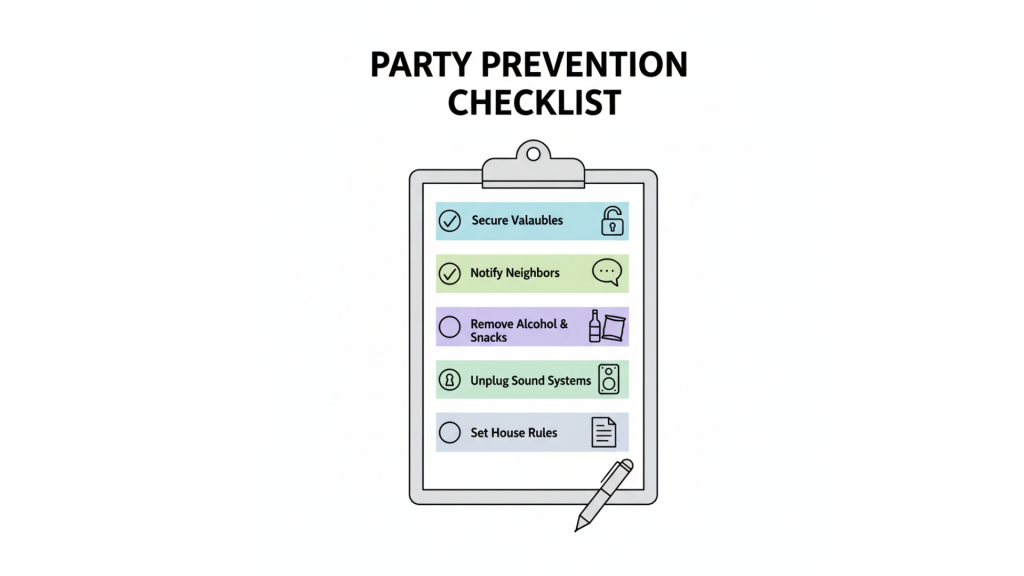
Party prevention requires multiple defensive layers. No single approach is foolproof, but combining methods dramatically reduces risk.
Start with intelligent booking policies. Use data-driven risk scoring rather than blanket restrictions. This preserves revenue from legitimate local guests while flagging suspicious patterns.
Implement automated guest screening. AI vacation rental automation analyzes booking requests faster and more consistently than manual review.
Deploy redundant security systems. As this incident proved, backup cameras placed strategically capture what primary systems miss. Disclose all devices in your listing to maintain legal compliance.
Establish rapid response protocols. Whether you have an in-house team or use automated coordination tools, documented procedures reduce crisis response time.
Prepare legal documentation systems. Small claims court cases depend on evidence quality. The host in this case knew she had a “slam dunk” claim because every interaction was documented, timestamped, and saved.
Platforms like AdvanceCM integrate these layers into a single system, from booking risk analysis through emergency response coordination.
Want to compare prevention costs to your current setup? Check the pricing calculator to see how automated party prevention fits your portfolio.
🛡️ Join the discussion with property managers sharing their party prevention strategies and real experiences
Conclusion
The host’s story ended as well as possible under the circumstances. She recovered most damages through Airbnb’s resolution center. The video evidence made legal action straightforward. And her compassionate response to the next guest, arriving for a funeral, demonstrated exceptional professionalism under pressure.
But the entire crisis was preventable. One policy exception, made under platform pressure to improve search rankings, resulted in $1,348 in damages, 12 hours of emergency response, strained neighbor relationships, and suspected involvement in organized crime.
Party prevention isn’t about paranoia. It’s about sustainable operations. Every property manager eventually faces the choice: invest in prevention now, or pay for incidents later. The math is simple. The choice is clear.
FAQs
Q: What are the biggest red flags for unauthorized parties?
A: One-night local bookings are the highest-risk category. Combine this with last-minute timing, new guest accounts, vague explanations, or resistance to house rules, and risk increases exponentially.
Q: How much does the average vacation rental party cost in damages?
A: Industry data shows unauthorized parties typically cause $1,000-$5,000 in direct damages, not including lost bookings, cleaning time, neighbor relations, or potential legal issues.
Q: Can I legally use security cameras for party prevention?
A: Yes, with proper disclosure. All recording devices must be clearly mentioned in your listing description. Focus cameras on entry points and common areas, never private spaces like bedrooms or bathrooms.
Q: What’s the best way to screen local guests without discrimination?
A: Use multi-factor risk scoring rather than blanket bans. Analyze booking timing, account age, communication style, and stated purpose together. This approach catches deceptive bookings while welcoming legitimate local guests.
Q: How quickly can AI systems detect unauthorized parties?
A: Modern monitoring platforms flag unusual activity within minutes. Constant door traffic, unusual late-night patterns, or attempts to disable security devices trigger immediate alerts, enabling intervention before major damage occurs.

Welcome to Tokeet’s Podcast — your trusted source for insights, trends, and strategies shaping the vacation rental industry. Each episode features expert interviews, data-driven analysis, and practical tips to help property managers grow their businesses, improve guest experiences, and stay ahead in a rapidly evolving market. Whether you’re new to short-term rentals or managing a large portfolio, tune in to stay informed and inspired.
Some days just don’t work for a guest arrival, whether it’s a holiday, a maintenance window, or a turnover day your team can’t cover. This episode walks through check-in and check-out restrictions, the most requested feature in AdvanceCM, now live in the Rentals module. You’ll hear how to block arrivals or departures for a date range, such as December 24 to 26, and how to allow check-ins only on the weekdays you choose. We also cover channel-specific rules, like keeping Airbnb to Friday and Saturday arrivals while direct bookings stay open through Sunday. Finally, we explain what to check before switching rules on, from existing reservations to sync time and visibility on booking sites.
Key Takeaways:
✅ Block check-ins or check-outs for any date range
✅ Limit arrivals to the weekdays you choose
✅ Set different rules for each booking channel
✅ Existing reservations stay unchanged
✅ More restrictions mean fewer guests can book, so review rules each season
Related Links:
Company: https://www.tokeet.com/Blogs: https://www.tokeet.com/blog/Blog: Check-in and Check-out Restrictions: How to Set Them in AdvanceCM 👉 https://blog.tokeet.com/check-in-and-check-out-restrictions/
This is a public episode. If you would like to discuss this with other subscribers or get access to bonus episodes, visit podcast.tokeet.com